acclaim-jk No Comments

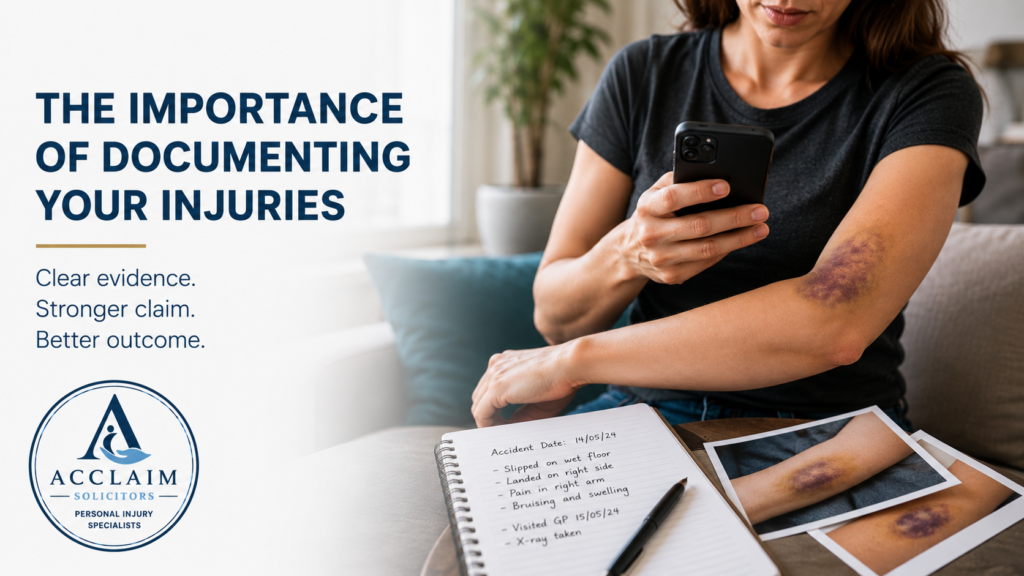
The Importance of Documenting Your Injuries After an Accident

If you’ve been injured in an accident that wasn’t your fault, your focus will naturally be on getting better. However, one of the most important things you can do during your recovery is keep a clear record of your injuries and the impact they are having on your life.

Whether you’ve been involved in a road traffic accident, suffered an injury at work, or experienced a slip, trip or fall, good documentation can make a significant difference to any personal injury claim. A successful personal injury claim relies on evidence. While you know what happened, insurers will often look for proof of how the accident occurred and how your injuries have affected you.

Photographs of the accident scene, damaged property and visible injuries can all help support your case. If there were witnesses, obtaining their contact details can also prove invaluable if liability is disputed later. The more evidence available, the easier it becomes to demonstrate what happened and the effect it has had on your daily life.

After any accident, it is important to seek medical advice as soon as possible. Some injuries may not be immediately obvious, and a medical professional can identify problems that could otherwise go untreated. Medical records also provide crucial evidence. They create an official link between the accident and your injuries, making it more difficult for insurers to argue that your symptoms were caused by something else

Your medical records are important, but they do not always tell the whole story. Keeping a simple diary can help record your pain levels, mobility issues and the challenges you face during recovery. You may find yourself unable to work, struggling with household tasks or missing out on hobbies and social activities. These day-to-day difficulties can form an important part of a personal injury claim and help demonstrate how the accident has affected your quality of life.

Injuries often create financial pressures as well as physical ones. Time away from work can result in lost earnings, while prescription charges, travel expenses and rehabilitation costs can quickly add up. Even relatively small expenses can become significant over the course of a recovery. Keeping receipts, invoices and wage records can help ensure that these losses are properly accounted for if a claim is pursued.

Gathering evidence while recovering from an injury can feel overwhelming. An experienced personal injury solicitor can help obtain medical records, collect supporting evidence and deal with insurers on your behalf. This allows you to focus on your recovery while ensuring your claim is supported by the strongest possible evidence.

If you have been injured in an accident that was not your fault, Acclaim Solicitors can provide clear legal advice and practical support throughout the claims process.

You can contact us by calling 01244 956434 or by filling in the contact form on our website.
acclaim-jk No Comments

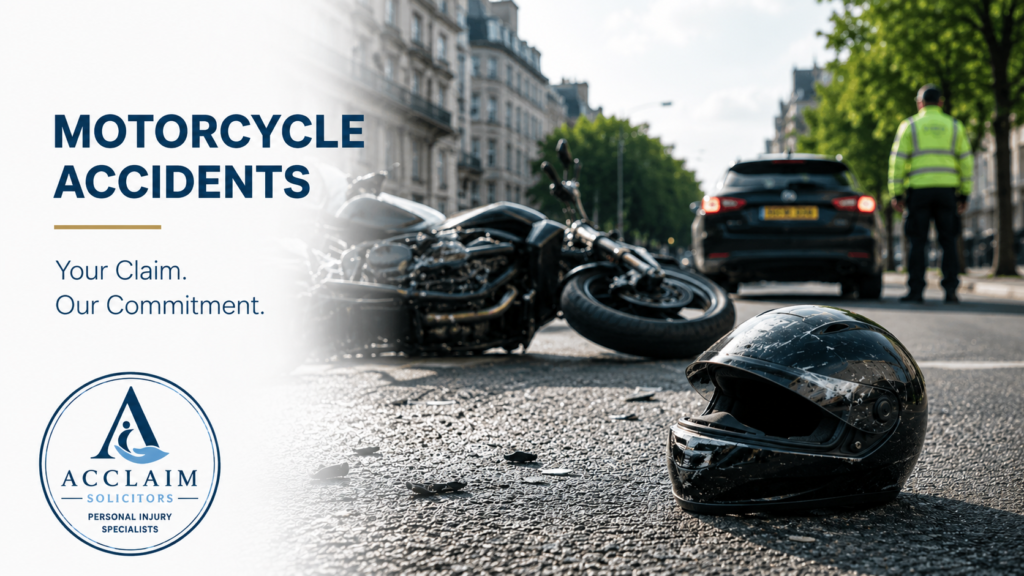
Motorcycle Accidents

Motorcyclists remain one of the most vulnerable sets of road users in the UK.

Despite motorcycles accounting for less than 1% of total road traffic, motorcyclists made up 21% of all road deaths in 2024, while thousands more suffered serious injuries. Unlike drivers and passengers in cars, motorcyclists have very little protection when a collision occurs.

Modern vehicles are designed with airbags, seatbelts, crumple zones, and reinforced passenger compartments. Riders, by comparison, rely largely on their skill, awareness, and protective clothing. Even relatively low-speed impacts can result in serious injuries, particularly when a rider is thrown from their motorcycle, and one of the most common causes of motorcycle collisions is simply not being seen.

Many accidents occur when a driver pulls out of a junction, changes lane, or turns across the path of an approaching motorcycle. Safety researchers often refer to this as the “looked but failed to see” phenomenon, where a driver looks in the rider’s direction but fails to properly register the motorcycle’s presence. This can be because motorcycles are smaller and narrower than cars, they can be harder to spot, especially in busy traffic or poor weather conditions.

While many accidents occur in urban areas, around 69% of motorcyclist fatalities happen on rural routes, despite only around 40% of motorcycle traffic taking place there. Higher speed limits, blind bends, hidden junctions, and changing road surfaces can all increase the likelihood of a serious collision.

Motorcycle accident patterns also differ from those of other road users, as many riders use motorcycles for leisure rather than commuting, meaning casualty figures often peak during weekends. The highest number of fatal and serious motorcycle collisions typically occurs between midday and late afternoon on Saturdays and Sundays.

Protective equipment can’t prevent an accident from happening, but it can play a crucial role in reducing the severity of injuries, and with head injuries remaining one of the leading causes of death in motorcycle accidents, wearing a properly fitted, approved helmet is one of the most important safety measures any rider can take, along with jackets, trousers, gloves, and boots, that can all make a substantial difference in an accident.

Motorcyclists are often unfairly blamed following a collision, even when another road user was responsible. However, riders have the same rights as any other road user when it comes to seeking compensation after an accident caused by someone else’s negligence.

Whether the collision involved a car, van, lorry, poorly maintained road surface, or another hazard, Acclaim Solicitors are here to advise on your next steps to take.

You can contact us by calling 01244 956434 or by filling in the contact form on our website.
acclaim-jk No Comments

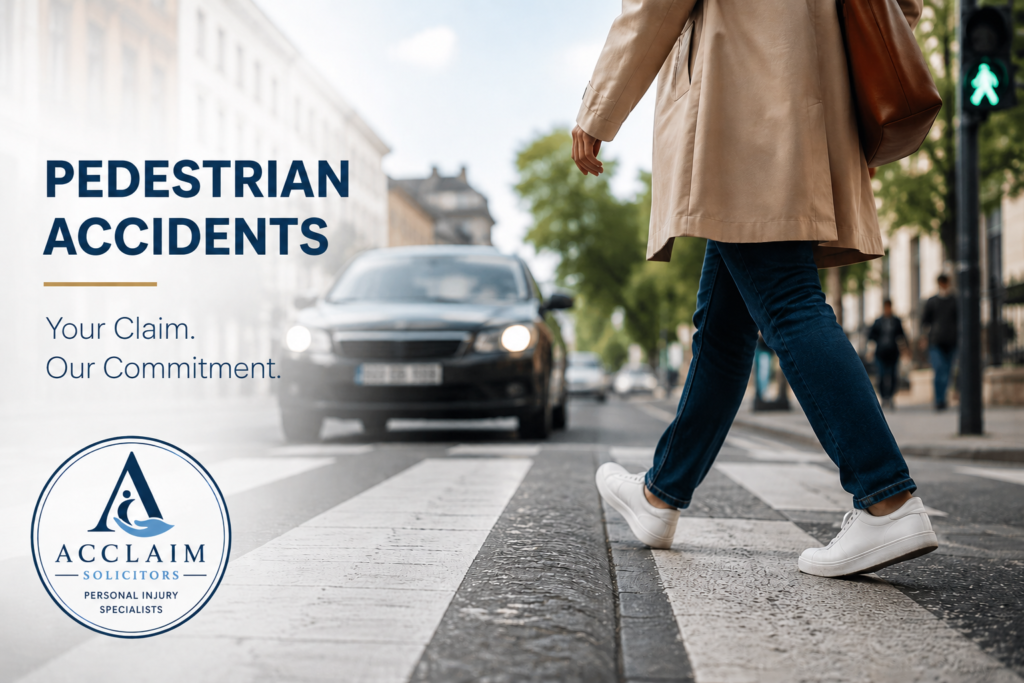
Pedestrian Accidents

Most of us have seen on the television and read online how walking is one of the healthiest, cheapest, and most environmentally friendly ways to travel, with millions of people across the UK walking to work, school, the shops, or simply for leisure every day.

Yet despite continued efforts to improve road safety, pedestrians remain one of the most vulnerable groups on Britain’s roads, as unlike drivers and passengers in cars, pedestrians have no physical protection when a collision happens, meaning even low-speed impacts can result in serious or life-changing injuries.

Recent statistics show that hundreds of pedestrians are killed and thousands more are injured on UK roads every year, highlighting the continued need for greater awareness among all road users, and while overall road deaths have generally declined over recent decades, pedestrian casualties remain a major road safety challenge, particularly in urban areas where people and vehicles interact most frequently.

Pedestrian accident hotspots in urban areas include; junctions and crossroads, where turning drivers can become more focused on other traffic rather than pedestrians, and although dedicated crossings are designed to improve safety, accidents still occur when motorists fail to stop or pedestrians misjudge traffic conditions.

Statistically, the 2 most high-risk groups of pedestrians to be involved in an accident are children and older adults, with children’s limited road experience and their developing awareness of their surroundings making it difficult for them to accurately judge vehicle speeds and road hazards. While reduced mobility and slower reaction times can make crossing roads more challenging for older adults.

Many pedestrian accidents could be prevented through greater care and awareness by the road users, examples being not using mobile phones and in-car technology while driving, as well as keeping to the speed limits and not driving while under the influence of alcohol or drugs.

The consequences of a pedestrian accident often extend far beyond the initial injury and victims of it may face long periods away from work, ongoing medical treatment, reduced mobility, psychological conditions such as anxiety or post-traumatic stress disorder, along with financial difficulties caused by lost earnings.

For those who have been injured because of a driver’s negligence, understanding your legal rights is important. Seeking specialist legal advice can help you access the support, rehabilitation, and compensation you may need to move forward after a serious accident.

With over 30 years of experience, our friendly and approachable team of experts are here to help you with clear guidance on the next steps you should take.

You can contact us by calling 01244 956434 or by filling in the contact form on our website.
acclaim-jk No Comments

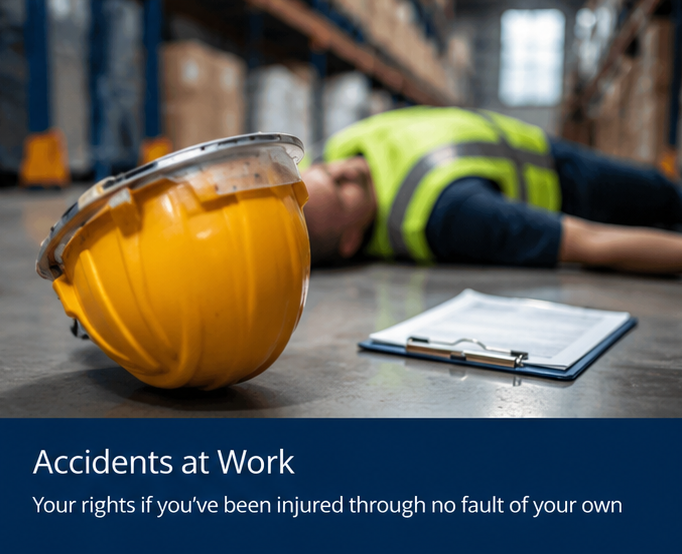
Accidents in the Workplace

Most of us spend a large part of our lives at work, be that in an office, warehouse, factory or on a building site, so it will come as no surprise that accidents happen across the UK every day in a variety of workplaces, even if you are doing everything correctly.

However, many people don’t realise that if you’ve been injured at work because of someone else’s negligence, you may be entitled to make a compensation claim.

Employers have a legal duty to provide a safe working environment for their staff. This includes carrying out risk assessments, providing suitable training, maintaining equipment, and taking reasonable steps to protect employees from harm.

If your employer fails in that duty and you suffer an injury as a result, you could have grounds to bring a personal injury claim.

You may well be worrying that making a claim will directly affect your employer, though most employers are required by law to hold employers’ liability insurance, which is designed to cover compensation claims made by injured workers. In most cases, it is the insurer that handles and pays any successful claim.

No matter what your injury, compensation is not just limited to the injury itself, a successful claim can also include financial losses and expenses that have arisen because of the accident. These can include; loss of earnings if you have had to take time off work, future loss of income if your injuries affect your ability to work, travel expenses for medical appointments, and more.

Every claim is different, and the amount of compensation will depend on the severity of the injury and the financial impact it has had, and will have, on your life.

Some of the incidents that happen more frequently than others include; manual handling accidents, where lifting, carrying, pushing or pulling heavy objects, can result in back injuries, muscle strains, and long-term mobility problems. Slips, Trips & Falls on uneven surfaces, spillages and trailing cables. Plus, faulty machinery and tools may lead to serious injuries that could otherwise have been avoided.

Being injured at work can have a significant impact on your health, finances, and family life. If the accident was caused by unsafe working practices, inadequate training, faulty equipment, or another form of employer negligence, you should not be left to deal with the consequences alone.

With over 30 years of experience, our friendly and approachable team of experts are here to help you with clear guidance on your next steps should you have suffered an accident at work.

You can contact us by calling 01244 956434 or by filling in the contact form on our website.
acclaim-jk No Comments

Falls from Height at Work

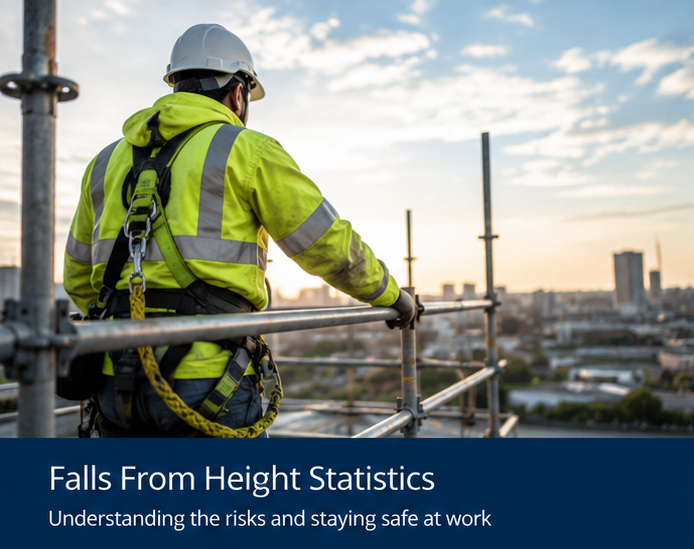
Falls from height continue to be the leading cause of workplace fatalities in Great Britain, particularly within construction, agriculture, manufacturing, and transport industries. Between 2020/21 and 2024/25, falls from height caused an average of 38 worker deaths every year.

However, the true number could be much higher, due to the way in which incidents are reported.

Employer reported accidents are recorded under the Reporting of Injuries, Diseases and Dangerous Occurrences Regulations, which in 2024/25 recorded 4,684 non-fatal falls from height.

In contrast to that, The Labour Force Survey asks workers directly about workplace injuries, and it estimates that up to 44,000 workers suffered injuries following falls from height during the same period.

That is a huge difference!

Also, these figures may not tell the full story, particularly among self-employed workers, who are less likely to report incidents through formal channels and who account for approximately two-thirds of fall from height incidents.

Construction remains the sector most closely associated with falls from height, which accounted for around half of all construction related deaths, due to falls from roofs, scaffolding, ladders and platforms. With Agriculture, Manufacturing, Transport and Warehousing also accounting for many fatal and non-fatal accidents due to a fall from height.

Non-fatal falls can have life-changing consequences, including broken bones, spinal injuries, permanent mobility issues, along with long term psychological effects. All of which can affect the ability to return to work due to lengthy rehabilitation, both physically and mentally, which can then lead to financial worries.

The current Work at Height Regulations require employers and those in control of work activities to avoid work at height where possible, and if it is necessary to work at height, to ensure that suitable protection measures are in place, that the work is properly planned and supervised using trained and competent workers with the correct safety equipment, and that regular maintenance and inspections are also undertaken.

Falls from height remain one of the most persistent workplace safety issues in the UK.

Acclaim Solicitors understand that behind every statistic is a worker, a family, and often a life permanently altered, and that making a personal injury claim can feel overwhelming, especially while recovering from an injury.

With over 30 years of experience, our friendly and approachable team of experts are here to help you with clear guidance on your next steps.

You can contact us by calling 01244 956434 or by filling in the contact form on our website.
acclaim-jk No Comments

Injured in an E-Scooter Accident? Know Your Rights.

Injured in an E-Scooter Accident? What is an E-Scooter?

Electric scooters—commonly known as e-scooters—are similar in design to traditional two-wheeled scooters but are powered by an electric motor. These vehicles typically reach speeds of up to 15 mph and are required to have both front and rear lights when used legally on public roads.

To ride an e-scooter legally in public, users must hold a full or provisional driving licence (car or motorcycle). While wearing a helmet is recommended for safety, it is not currently a legal requirement.

Are E-Scooters Legal?

In the UK, only e-scooters that are rented through government-approved trial schemes are legal to use on public roads. Privately owned e-scooters remain illegal on public highways, pavements, and cycle paths—they are permitted only on private land with the landowner’s permission.

Despite their increasing popularity, e-scooters have raised safety concerns. More than 70 people have reportedly been injured in trials across the country, including at least 11 who suffered serious injuries.

Know Your Rights – Have You Been Injured in an E-Scooter Accident?

If you’ve been injured by a motor vehicle while riding a rented e-scooter, and the driver was at fault, you may be entitled to compensation. In most cases, the driver’s insurer will be liable. If the driver is uninsured, the Motor Insurers’ Bureau (MIB) may step in to cover your claim.

However, claims involving pedestrians injured by e-scooter riders can be much more complex:

  • If the e-scooter was part of a government trial, the rental company should have provided insurance.
  • If the e-scooter was privately owned, insurance is not required—and these vehicles are illegal to use on public roads and pavements. In such cases, the rider is committing a criminal offence.
  • Unfortunately, because privately owned e-scooters are typically uninsured, claims for pedestrian injuries can be difficult to pursue unless the rider has personal means to pay compensation.
  • The MIB will not cover accidents involving illegal use of private e-scooters.

What Should You Do After an E-Scooter Accident?

If you are a pedestrian involved in an e-scooter collision, it’s crucial to gather as much information as possible at the scene, including:

  • The rider’s name and address
  • Any available insurance details
  • Photographs of the scene and damage
  • Contact details of any witnesses

Even if the claim may seem complicated, it is still worth seeking legal advice.

How Acclaim Solicitors Can Help

E-scooter accidents can result in serious, life-altering injuries, and the legal landscape around them continues to evolve. At Acclaim Solicitors, our team of specialist personal injury lawyers have extensive experience in handling complex and unusual claims.

We can advise you on:

  • Whether you have a valid compensation claim
  • What options are available if the responsible party is uninsured
  • Recovering costs for medical treatment, loss of income, and other damages

Let us help you understand your legal rights and pursue the compensation you deserve.

Contact Acclaim Solicitors today for expert advice and compassionate legal support.

acclaim-jk No Comments

How long can a compensation claim take to settle in the UK?

There’s no fixed timeframe for settling a compensation claim—just as there’s no guaranteed amount you’ll receive. Every case is different, and the duration depends on several factors, including the type of accident, the seriousness of your injuries, and whether the case proceeds to court.

In this guide, we’ve answered some of the most frequently asked questions, such as:
How long does a personal injury claim usually take?
When will I receive my compensation after a settlement?
Is it possible to settle my claim early?
What could be causing delays in my claim?
Read on to learn more. Or, if you’d prefer personalised advice, our friendly legal team is ready to help—just fill out our contact form.
How long does a personal injury claim take?
No two claims are exactly alike. Whether you’ve suffered an accident or experienced medical negligence, the timeframe for settling your claim will vary depending on the specifics of your case.
For instance, straightforward claims like minor whiplash from a car accident tend to be resolved much faster—especially now that road traffic claims can be processed through a government-run online portal. In contrast, complex cases such as those involving medical negligence often take longer due to the need for more in-depth investigation and evidence gathering.
If your injuries are more serious, your solicitor may arrange a medical assessment. In such cases, the medical expert might need additional time to fully evaluate the long-term impact before providing a report.
While simpler claims may settle within six months, more complicated ones can take up to three years or longer. That said, you do need to start your claim within three years of the incident, but there’s no deadline for final settlement—so there’s no risk of running out of time once the process has begun.
When will I receive my compensation after settlement?
In most No Win No Fee cases, your compensation is first paid to your solicitor, who deducts their success fee before transferring the remainder to you.
Typically, solicitors take up to 25% of the final compensation for personal injury claims—or up to 35% plus VAT in road traffic accident cases, due to changes in legislation.
Once your claim is settled, it can take up to 28 days for the funds to reach your account, although many people receive their compensation sooner—sometimes within a few days if the insurer processes payment quickly.
If your solicitor has your bank details, payment will usually be made via direct transfer. Otherwise, you may receive a cheque, which could take slightly longer to arrive.
No Win No Fee – Only Pay If You Win
With our No Win No Fee agreement, you’ll only pay a success fee if your claim is successful. This fee is capped at a percentage of your compensation—no more than 25% for most claims.
At Acclaim Solicitors, we take pride in our trusted reputation we’ve built for delivering excellent results and client care.
Can I settle my claim early?
You always have the option to accept an early settlement offer—but it’s important to proceed with caution. Accepting too soon could mean missing out on a higher payout if your solicitor believes the claim is worth more.
Immediately after an accident, the full extent of your injuries may not yet be clear. Accepting an offer too early could result in compensation that doesn’t reflect future impacts on your health, career, or income.
If you’re struggling financially and tempted to settle for quick relief, speak to your solicitor about interim payments. These are partial payments made before a final settlement, helping you manage urgent costs without compromising your case’s full value.
Why is my compensation taking so long?
Several factors can slow down the settlement process, including:
Difficulty locating the responsible party: This often happens in hit-and-run accidents. Your solicitor may need to refer the case to the Motor Insurers’ Bureau, which has its own investigation timescales.
Liability disputes: If the other party denies fault, your solicitor will need time to gather additional evidence, which could delay the case.
Ongoing medical recovery: If you haven’t fully recovered, updated medical assessments may be needed to ensure your claim accurately reflects the severity and long-term effects of your injuries.
After an initial consultation, your solicitor will provide a clearer estimate based on the details of your case. Throughout the process, they’ll work to reduce stress and keep you informed every step of the way.
Speak to an Expert Today
Ready to explore your options? At Acclaim Solicitors, our team is here to guide you. Give us a call on 01244 956434 or via our contact page, and we’ll be in touch shortly for a no-obligation chat.


acclaim-jk No Comments

What’s the Maximum Weight You Can Safely Lift at Work?

Accident at Work Injury
Have you suffered an Accident at Work Injury?

What’s the Maximum Weight You Can Safely Lift at Work?

By Acclaim Solicitors | 📞 01244 956434 | 🌐 acclaimsolicitors.co.uk

Whether you work in construction, logistics, retail, or care, manual handling is often a part of the job. But lifting too much—or lifting incorrectly—can lead to serious injury. Knowing your rights and limits isn’t just good practice; it’s essential.

Here’s what you need to know about maximum weight limits at work—and what to do if you’re injured.

Manual Handling: What the Law Says

Health and Safety Executive (HSE) guidelines recommend maximum lifting weights to prevent injuries. These limits vary depending on:

  • Your gender
  • The height at which the load is lifted
  • Whether the load is held close or away from your body

These are not strict legal limits but are widely used as best practice across UK workplaces.

Maximum Lifting Limits for Men

According to HSE guidelines, men should not exceed:

Load held close to the body Load held further away
Head Height 10kg 5kg
Shoulder Height 20kg 10kg
Elbow Height 25kg 15kg
Mid-lower leg height 10kg 5kg


Maximum Lifting Limits for Women

For women, the maximum recommended weights are:

Load held close to the body Load held further away
Head Height 7kg 3kg
Shoulder Height 13kg 7kg
Elbow Height 16kg 10kg
Mid-lower leg height 7kg 3kg


Why Height and Distance Matter

The higher you lift—or the further away from your body the load is—the more strain you place on your muscles and joints. That means a load that’s safe to lift from waist height might be dangerous at shoulder or head height.

Can You Refuse to Lift Heavy Loads at Work?

Yes—if it’s unsafe to do so.

You can and should raise concerns with your line manager, especially if:

  • You haven’t received manual handling training
  • No risk assessment has been carried out
  • The load exceeds the recommended safe limits

Your employer has a legal responsibility to ensure you’re not being asked to perform tasks that put you at risk.

Injured While Lifting at Work? Know Your Rights

If you’ve suffered a manual handling injury in the workplace, you may be entitled to compensation. Many workers are unaware that:

  • Your employer’s insurance pays compensation—not the employer directly.
  • You can’t be sacked for making a claim.
  • Unfair dismissal claims can be brought if you are treated badly for speaking up.

Get Free Legal Advice Today

At Acclaim Solicitors, we specialise in personal injury and accident-at-work claims. If you’ve been injured lifting at work, we’re here to help—no pressure, no jargon, just clear guidance on your next steps.

You can contact us by calling 01244 956434 or by filling in our contact form.

📞 Call us on 01244 956434
Email info@acclaimls.co.uk
💬 Free initial chat | No obligation

acclaim-jk No Comments

UK Law on Dogs Travelling in Vehicles: Do’s and Don’ts

UK Law on Dogs Travelling in Vehicles

What you ned to know about Dogs travelling in vehicles


UK Law on Dogs Travelling in Vehicles: Do’s and Don’ts

Taking your dog along for a ride can be a fun experience, but it’s important to make sure that both you and your furry friend are safe while on the road. In the UK, there are specific rules and guidelines regarding how pets should be transported in vehicles. Not following these rules could lead to fines or, in the worst case, accidents. In this blog post, we’ll explain the UK law on dogs travelling in vehicles and highlight some important do’s and don’ts.

The UK Law on Dogs in Vehicles

According to the Road Traffic Act 1988, the law requires that a driver must maintain full control of their vehicle at all times. This includes making sure that pets are safely secured. While there is no specific law stating that dogs must be restrained, failing to do so could lead to charges under the broader rule of not driving without due care and attention.

Under the Highway Code, Rule 57 specifically mentions that dogs should be properly secured when travelling in vehicles. A dog that’s not properly restrained can be a distraction to the driver and could be dangerous to both the animal and passengers in the event of a sudden stop or accident.

Do’s: Safe Practices for Travelling with Dogs

  1. Secure Your Dog:
    It’s essential to use some form of restraint to keep your dog safe. This can include:

    • A dog seat belt harness that attaches to the vehicle’s seat belt.

    • A dog crate or carrier, which is one of the safest options.

    • A dog guard that separates the back seat from the boot (for larger dogs in estate or hatchback cars).

    Securing your dog not only protects them but also prevents them from distracting you while driving.

  2. Use a Dog-Friendly Car Seat:
    If you have a small dog, a dog car seat can be a great option. These seats are designed to hold your dog in place safely and prevent them from moving around during the journey.

  3. Allow Breaks on Long Journeys:
    Long trips can be stressful for dogs, so make sure to stop regularly for water, toilet breaks, and a chance to stretch their legs. This is especially important for ensuring your dog’s comfort and safety.

  4. Keep Windows Partially Open (If Safe):
    If your dog enjoys sticking their head out of the window, make sure it’s done safely. A cracked window can allow fresh air, but don’t roll the window all the way down, as this could lead to your dog jumping or falling out.

  5. Bring Water and Snacks:
    Keep water and a few snacks handy to keep your dog hydrated and comfortable, especially during long trips.

Don’ts: Mistakes to Avoid When Travelling with Dogs

  1. Never Let Your Dog Roam Free in the Car:
    Allowing your dog to wander around the vehicle is a major safety hazard. Not only can it be distracting, but your dog could be seriously injured if you have to stop suddenly. A dog unrestrained in the car could also be thrown around or even out of the vehicle during an accident.

  2. Don’t Leave Your Dog Unattended in the Car:
    Leaving your dog alone in the car can be extremely dangerous, especially during hot weather. Even with the windows slightly open, the inside of a vehicle can heat up quickly, leading to heatstroke, which can be fatal. The RSPCA strongly advises against leaving pets in vehicles for this reason.

  3. Avoid Transporting Dogs in the Front Seat:
    Although it may seem like a fun idea, it’s best not to let your dog sit in the front passenger seat. In the event of an accident, the airbag could harm your dog. Additionally, the dog could distract you while driving, especially if they’re trying to climb onto your lap.

  4. Don’t Let Your Dog Lean Out of the Window:
    While it’s common for dogs to love the feeling of wind in their faces, this can be risky. If you’re driving at high speeds, the wind can cause injury, and there’s also the possibility of debris or other hazards getting into your dog’s eyes or mouth.

  5. Don’t Feed Your Dog Right Before the Trip:
    Feeding your dog immediately before travelling can cause discomfort, and some dogs may experience motion sickness. It’s best to feed your dog at least an hour or two before you leave.

Why You Should Follow These Guidelines

Not only does following these simple steps ensure your dog’s safety, but it also prevents you from being fined for distracted driving. If your dog is not properly restrained, it could result in a large fine and penalty points on your driving licence. More importantly, ensuring that your dog is safe and secure helps reduce the risk of accidents and injury to all passengers in the car.

Key Takeaways

  • Secure Your Dog: Use a harness, crate, or guard to prevent distractions and ensure your dog’s safety.

  • Don’t Let Your Dog Roam Free: Keep your dog in one place to avoid distractions while driving.

  • Avoid Leaving Your Dog Alone in the Car: Never leave your dog unattended, especially in hot weather.

  • Don’t Let Your Dog Sit in the Front Seat: Always make sure your dog is in the back seat, securely restrained.

Useful Resources

  • Highway Code – Rule 57 for advice on transporting animals safely in vehicles.

  • RSPCA Advice on Dogs in Cars: RSPCA – Dogs and Cars

By following these simple guidelines, you can ensure a safe and enjoyable journey for both you and your furry friend. Stay safe and keep your dog secure when on the road!

acclaim-jk No Comments

Safe Driving Practices and Essential Steps After a Road Traffic Collision in the UK


Safe Driving PracticesSafe Driving Tips and What to Do After a Car Accident in the UK

    • Driving is something most of us do every day, but staying safe on the road requires more than just following the rules. It’s about being aware of your surroundings, staying focused, and knowing what to do if things go wrong. In this blog post, we’ll cover some important safe driving tips and what to do if you’re involved in a road traffic accident in the UK.
Road Safety in the UK: The Latest Stats

According to the latest government data, road safety is improving, but there’s still work to be done:
Fatalities: Sadly, 1,607 people lost their lives in road accidents in the year ending June 2024. This represents a slight decrease of 2% from the previous year.
Serious Injuries: Around 29,540 people were either killed or seriously injured in road accidents. While this number hasn’t changed much, it highlights the ongoing need for safety on the roads.
Total Casualties: There were 128,920 road accidents in total, including minor injuries, showing a 4% drop from the previous year.
These numbers remind us how important it is to stay safe on the roads and follow safe driving habits.

What Causes Road Accidents?

To prevent accidents, it’s helpful to know what causes them. Here are the main culprits:
Speeding: Going too fast is one of the biggest causes of fatal accidents. Speeding not only increases the chance of a crash but also the severity.
Distracted Driving: Using your phone, fiddling with the radio, or getting distracted by passengers can make you less aware of what’s going on around you. Distracted drivers are up to four times more likely to have an accident.
Driving Under the Influence: Whether it’s alcohol, drugs, or even tiredness, driving under the influence can impair your reaction times and judgment. Never get behind the wheel if you’re not fully alert.
Bad Weather: Rain, snow, and fog can make roads slippery and harder to navigate. Always adjust your driving to match the weather conditions.

Simple Tips for Safe Driving

We all want to stay safe on the roads. Here are some simple driving tips that can help:
Stick to Speed Limits: Always drive within the speed limit, and slow down if road conditions are poor or if you’re driving in an area with lots of pedestrians or cyclists.
Stay Focused: Put your phone down, focus on the road, and avoid distractions. It’s better to pull over if you need to make a call or send a message.
Don’t Drink and Drive: If you plan to drink, make sure you have a designated driver or use public transport. Even a small amount of alcohol can impair your driving.
Keep a Safe Distance: Follow the “two-second rule” – leave a two-second gap between you and the car in front. This gives you enough time to react if they suddenly stop.

What to Do If You’re Involved in a Road Traffic Accident

If you’re ever involved in a car accident, staying calm and knowing what to do can make all the difference:
Stay Safe: If you can, move to a safe spot without blocking traffic or causing further risks. Turn on your hazard lights to warn other drivers.
Check for Injuries: Make sure everyone involved is okay. If someone is hurt, call an ambulance immediately by dialing 999 or 112.
Call the Police: If there are injuries, significant damage, or if the other driver refuses to exchange details, contact the police. You’ll need to file a report for insurance purposes.
Exchange Details: Swap names, addresses, car registration numbers, and insurance details with the other driver(s). If there are witnesses, get their contact info as well.
Take Photos: Document the scene of the accident, including any damage, skid marks, and the surrounding area. This can be helpful for insurance claims and investigations.
Notify Your Insurance Company: Let your insurer know about the accident as soon as possible, even if it was minor. They’ll guide you on the next steps for filing a claim.

Contacting Acclaim Solicitors for Claims

If you’ve been involved in a road traffic accident and need assistance with making a claim, Acclaim Solicitors are here to help.
Our experienced team can guide you through the process, ensuring you get the compensation you deserve.

How to Reach Us:
Call Us: Contact Acclaim Solicitors on 01244 956434.
Email Us: Reach out via email at info@acclaimls.co.uk.
Website: Visit our website at www.acclaimls.co.uk to learn more or schedule a consultation.

Useful Contacts After an Accident

Here are some key numbers and resources to have on hand:
Emergency Services: Dial 999 or 112 for an emergency, such as if someone is injured or trapped.
Non-Emergency Police: If it’s a minor incident or you need to report something after the fact, contact your local police station.
Your Insurance Company: Have your insurer’s phone number ready to report an accident quickly.
Road Safety Information: For more tips and advice on staying safe on the roads, check out the UK Government’s Road Safety Page.

Final Thoughts

Accidents can happen, but by driving safely and knowing the steps to take after a collision, you can minimize the risks and handle the situation with confidence. Stay alert, stay safe, and always be prepared!